Predict Biophysical Properties
Forecast quantitative developability metrics and flag clinical liability risks using multi-modal machine learning models.
The Predict Biophysical Properties tool uses regularized multi-modal linear models trained on 180+ clinical-stage therapeutic antibodies from Jain et al. (2017), Tomar et al. (2016), Sharma et al. (2014), and Shehata et al. (2019) to predict 10 critical biophysical developability attributes from sequence-based DeepSP convolutional neural network descriptors, 3D structural surface patches, electrostatics, CDR loop lengths, and antibody language models.
Accessing the Tool
Select one or more antibody entries in the Project View results grid. Go to the Analysis menu and select Predict Biophys.
Note: DeepSP sequence spatial models allow rapid in silico developability predictions for any clone with heavy and light chain sequences. When 3D coordinate models are available, structural surface patch descriptors (
SPN,SPP,SPH,SPCD) are automatically integrated into the prediction pipeline.
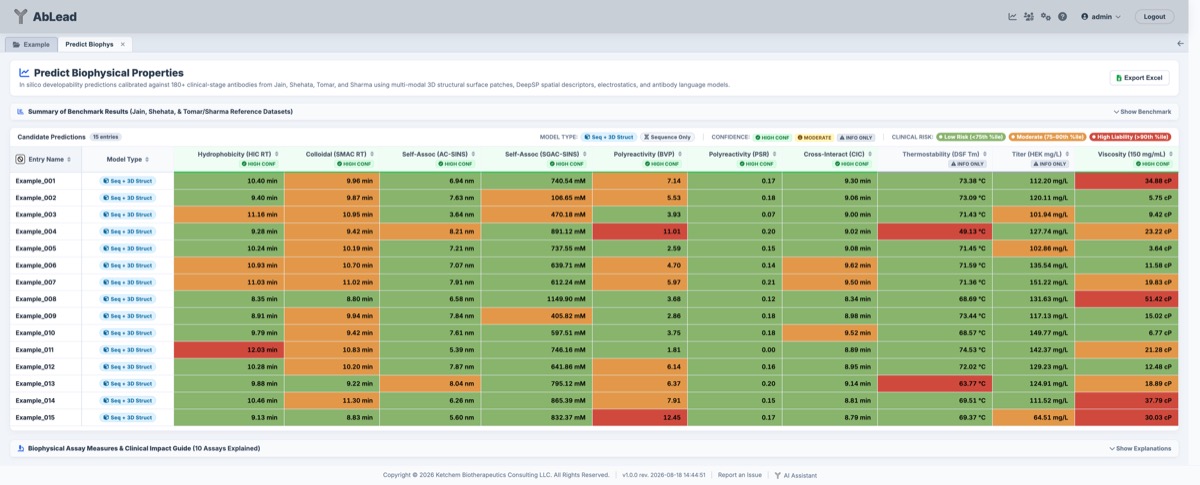
Biophysical Assay Measures & Clinical Significance
The platform forecasts 10 quantitative developability endpoints corresponding to the biophysical screening cascades established by Jain et al. (2017), Tomar et al. (2016), and Sharma et al. (2014):
1. Hydrophobicity (HIC Retention Time, min)
- Experimental Assay: Hydrophobic Interaction Chromatography (HIC HPLC on Butyl-NPR stationary phase).
- Biophysical Mechanism: Measures the interaction of the intact antibody with hydrophobic column ligands under a descending ammonium sulfate gradient.
- Key Drivers: Exposed hydrophobic surface patches, particularly clustered in CDR-H3 and CDR-H2 (
DeepSP: SAP_pos_CDR,SPN,pI). - Clinical Impact: High hydrophobicity accelerates non-specific in vivo hepatic clearance, shortens serum terminal half-life, promotes high-concentration solution viscosity, and causes phase separation or precipitation during downstream processing.
- Clinical Risk Threshold: High Liability \(\ge 10.82\text{ min}\) (top 10th percentile).
2. Colloidal Stability & Self-Interaction (SMAC Retention Time, min)
- Experimental Assay: Stand-up Monolith Affinity Chromatography (SMAC HPLC).
- Biophysical Mechanism: Quantifies non-specific self-interaction and colloidal dispersion stability on a cross-linked matrix under physiological formulation conditions.
- Key Drivers: Attractive colloidal interactions and extended CDR loop conformations (
DeepSP: SAP_pos_CDRH2,North CDR-H3,SPN). - Clinical Impact: Prolonged retention is a leading clinical liability driver for solution opalescence, reversible high-concentration self-clustering, liquid-liquid phase separation, and high dynamic injection viscosity in pre-filled syringes.
- Clinical Risk Threshold: High Liability \(\ge 11.23\text{ min}\) (top 10th percentile).
3. Self-Association (AC-SINS \(\Delta\lambda_{\text{max}}\), nm)
- Experimental Assay: Affinity-Capture Self-Interaction Nanoparticle Spectroscopy (AC-SINS).
- Biophysical Mechanism: Measures the plasmon resonance wavelength red-shift (\(\Delta\lambda_{\text{max}}\)) of gold nanoparticles coated with antibody when candidate mAbs cluster.
- Key Drivers: Localized patch electrostatics, isoelectric point (\(\text{pI}\)), and CDR negative charge distribution (
DeepSP: SCM_neg_CDRH2, \(\text{pI}\)). - Clinical Impact: Elevated red-shifts signal high propensity to form soluble oligomers, leading to shelf-life instability, turbidity, and high viscosity at high therapeutic doses (\(>100\text{ mg/mL}\)).
- Clinical Risk Threshold: High Liability \(\ge 11.90\text{ nm}\) (top 10th percentile).
4. Self-Association Salt Threshold (SGAC-SINS, mM \((NH_4)_2SO_4\))
- Experimental Assay: Salt-Gradient Affinity-Capture SINS (SGAC-SINS AS100).
- Biophysical Mechanism: Determines the ammonium sulfate concentration required to completely dissociate nanoparticle self-association (AS100).
- Key Drivers: Hydrophobic patch clustering and CDR structural packing (
DeepSP: SAP_pos_CDR,DeepSP: SAP_pos_Hv,SPN,North CDR-L3). - Clinical Impact: Low required salt concentrations indicate easily remediated self-association, whereas high salt thresholds identify stubborn, salt-resistant self-association that cannot be mitigated by standard formulation buffer adjustments.
- Clinical Risk Threshold: High Liability \(\le 249.4\text{ mM}\) (bottom 10th percentile).
5. Polyreactivity (PSR SMP Score, 0–1)
- Experimental Assay: Poly-Specificity Reagent (PSR) Soluble Membrane Protein (SMP) Assay.
- Biophysical Mechanism: Flow cytometric or binding assay measuring interaction with a complex detergent-solubilized membrane protein extract.
- Key Drivers: Surface electrostatics, high positive isoelectric point (\(\text{pI}\)), and uncoordinated basic residues (
pI,DeepSP: SCM_neg_CDRH1). - Clinical Impact: High polyreactivity leads to rapid systemic clearance via off-target tissue sinks, reduced bio-distribution to the target tissue, and high background in diagnostic or binding assays.
- Clinical Risk Threshold: High Liability \(\ge 0.22\text{ score}\) (top 10th percentile).
6. Polyreactivity (BVP ELISA Score)
- Experimental Assay: Baculovirus Particle (BVP) ELISA.
- Biophysical Mechanism: Quantifies non-specific antibody binding to immobilized whole baculovirus particles containing complex viral lipids and glycoproteins.
- Key Drivers: Unnatural framework substitutions and positive charge clustering in the CDRs (
AbLang2 FR,DeepSP: SCM_pos_CDR,IgBert Full,CDR Sum). - Clinical Impact: Strong BVP binding predicts high risk of immunogenicity, injection-site reactions, and rapid non-specific in vivo clearance.
- Clinical Risk Threshold: High Liability \(\ge 5.09\text{ score}\) (top 10th percentile).
7. Cross-Interaction (CIC Retention Time, min)
- Experimental Assay: Cross-Interaction Chromatography (CIC HPLC on immobilized human serum polyclonal IgG).
- Biophysical Mechanism: Measures retention on an analytical column immobilized with bulk polyclonal human IgG to detect non-specific antibody-antibody cross-interactions.
- Key Drivers: Localized CDR/framework surface charge patches and naturalness (
DeepSP: SCM_neg_CDRL1,DeepSP: SCM_neg_Lv,DeepSP: SCM_neg_CDRH1,AbLang FR). - Clinical Impact: Elevated CIC retention times correlate directly with shortened human terminal elimination half-life (\(t_{1/2}\)) due to FcRn-independent clearance.
- Clinical Risk Threshold: High Liability \(\ge 10.66\text{ min}\) (top 10th percentile).
8. Thermostability (DSF Fab \(T_m\), °C)
- Experimental Assay: Differential Scanning Fluorimetry (DSF).
- Biophysical Mechanism: Measures the thermal denaturation midpoint (\(T_m\)) of the Fab variable/constant domain using fluorescent hydrophobic reporter dyes.
- Key Drivers: Heavy/light chain variable domain interface packing, internal core framework rigidity, and CDR loop stability (
AbLang2 Full,North CDR-H2,IgBert Full,DeepSP: SAP_pos_CDRL2). - Clinical Impact: Low Fab \(T_m\) (\(<65^\circ\text{C}\)) increases susceptibility to thermal unfolding, irreversible chemical degradation, and accelerated aggregation during room-temperature shipping or storage.
- Clinical Risk Threshold: High Liability \(\le 68.6^\circ\text{C}\) (bottom 10th percentile).
9. Expression Titer (HEK Transient Titer, mg/L)
- Experimental Assay: Small-scale transient transfection and expression in mammalian HEK293 suspension cells.
- Biophysical Mechanism: Measures secreted antibody concentration in cell culture supernatant prior to clone or process optimization.
- Key Drivers: Chain pairing kinetics, intracellular chaperone engagement, and framework codon compatibility (
AbLang FR,IgBert FR,DeepSP: SCM_pos_CDRL1,DeepSP: SCM_neg_CDRL1,CVV FR). - Clinical Impact: Poor expression yields (\(<50\text{ mg/L}\)) signal biomanufacturing bottlenecks, low downstream purification recovery, and increased development costs.
- Clinical Risk Threshold: High Liability \(\le 18.0\text{ mg/L}\) (bottom 10th percentile).
10. High-Concentration Viscosity (Viscosity at 150 mg/mL, cP)
- Experimental Assay: High-concentration dynamic solution cone-and-plate rheometry at \(150\text{ mg/mL}\) in physiological formulation buffer (\(\text{pH } 5.5\text{–}6.0\)).
- Biophysical Mechanism: Quantifies dynamic solution resistance to laminar shear flow under high macromolecular packing density. Governed by asymmetric electrostatic dipole moments, exposed hydrophobic patches, and transient reversible cluster networks.
- Key Drivers: Net charge dipole asymmetry, exposed hydrophobic surface patches, and CDR charge clustering (
DeepSP: SAP_pos_Fv,DeepSP: SCM_pos_CDR,DeepSP: SCM_pos_CDRH3,CVV FR,SPN). - Clinical Impact: High viscosity (\(>20\text{ cP}\) or \(>50\text{ cP}\)) impairs syringeability through standard 27G–30G autoinjector needles, causes high patient injection pain during subcutaneous delivery, and forces formulation dilution or frequent intravenous clinic infusions.
- Clinical Risk Threshold: Warning \(> 15.05\text{ cP}\) (\(75\text{th percentile}\)), High Liability \(> 25.27\text{ cP}\) (\(90\text{th percentile}\)), Severe Liability \(> 50.0\text{ cP}\).
Model Architecture & Training Methodology
AbLead's developability predictors are regularized multi-modal linear models designed to forecast continuous experimental biophysical assay readouts and flag outlier liabilities directly from sequence and 3D structural features.
1. Training Cohort & Dataset Curation
The prediction models were trained and calibrated on standardized clinical antibody datasets representing the broad spectrum of approved and clinical-stage therapeutic mAbs:
- Clinical Screening Cascade (\(N=137\)): Curated from Jain et al. (2017) (PNAS), comprising 137 clinical-stage antibodies characterized across 9 standardized developability assays: Hydrophobic Interaction Chromatography (HIC), Stand-up Monolith Affinity Chromatography (SMAC), AC-SINS, Salt-Gradient SINS (SGAC-SINS), Poly-Specificity Reagent (PSR), Baculovirus Particle (BVP) ELISA, Cross-Interaction Chromatography (CIC), Differential Scanning Fluorimetry (\(T_m\)), and HEK293 transient expression titer.
- High-Concentration Viscosity Cohort (\(N=44\)): Curated from clinical rheology datasets published by Tomar et al. (2016) (Protein Science, \(N=27\)) and Sharma et al. (2014) (PNAS, \(N=17\)), measuring dynamic solution shear viscosity at \(150\text{ mg/mL}\) in formulation buffer (\(\text{pH } 5.5\text{–}6.0\)).
- Cross-Validation & Specificity Alignment: Re-evaluated and aligned against clinical polyspecificity panels from Shehata et al. (2019) (Cell Reports, \(N=137\)).
- Data Standardization: Full variable domains (Fv) were aligned and numbered under standardized schemes (IMGT and North CDR definitions). Sequences with available experimental coordinates or high-confidence Fv structural models were profiled to extract both 3D surface and 1D sequence descriptors.
2. Multi-Modal Candidate Feature Space
For each antibody, a multi-scale feature vector spanning 45+ biological, physical, and computational descriptors was extracted:
- 3D Structural Surface Patch Properties: Solvation potential descriptors computed on 3D coordinate models, including Solvation Potential Hydrophobic (
SPH), Positive (SPP), Negative (SPN), and Charge Disruption (SPCD). - DeepSP 2D Convolutional Spatial Descriptors: 30 sequence-based spatial descriptors generated by DeepSP convolutional neural networks (Tang et al., 2024), modeling Spatial Aggregation Propensity (
SAP) and Spatial Charge Maps (SCM) across individual CDR loops (CDRH1–CDRH3,CDRL1–CDRL3), variable heavy/light chains (Hv,Lv), and whole variable domains (Fv). - Protein Language Model (pLM) Likelihoods: Per-residue pseudo-perplexity and log-likelihood deviation scores capturing framework naturalness and evolutionary fitness from
AbLang(Full/FR),AbLang2(Full/FR), andIgBERT(Full/FR). - Canonical Rules & Structural Constraints: Canonical Viability Violations (
CVV Full,CVV FR), North CDR loop lengths (L1,L3,H1,H2,H3,CDR Sum), and# Disrupted CDR3 Salt Bridgecounts. - Global Electrostatics & Humanness: Isoelectric point (\(\text{pI}\) Bjellqvist) and
OASignhumanness scores (OASign VL,OASign VH,OASign Fv).
3. Stepwise Forward Feature Selection
To prevent over-parameterization and isolate the primary physical drivers of each assay, features were selected using a greedy forward stepwise selection algorithm optimizing cross-validated correlation:
- Initial Pool: For each target assay \(y\), all candidate descriptors with non-zero variance were evaluated.
- Iterative Addition: At each step \(k \le 7\), every unselected feature \(f\) was temporarily added to the active feature set \(S\).
- Regularization Optimization: For each candidate set \(S \cup \{f\}\), Leave-One-Out Cross-Validation (LOOCV) was performed across a grid of Ridge penalty parameters \(\alpha \in \{0.1, 0.5, 1.0, 2.0, 5.0, 10.0, 20.0, 50.0, 100.0\}\).
- Selection Criterion: The feature and \(\alpha\) yielding the highest LOOCV Spearman rank correlation \(\rho\) were added to \(S\), provided the improvement exceeded a minimum threshold (\(\Delta\rho > +0.005\)). The process terminated when no additional feature improved correlation or when 7 features were selected.
4. Regularized Ridge Regression Formulation
Each predictor is formulated as an L2-regularized Ridge regression model. Let \(X \in \mathbb{R}^{n \times p}\) denote the matrix of selected features for \(n\) antibodies, standardized to zero mean and unit variance:
Let \(y_c = y - \mu_y\) denote the centered target assay vector. The optimal weight vector \(w \in \mathbb{R}^p\) and intercept \(b = \mu_y\) are calculated via:
During inference for a new candidate with feature vector \(x \in \mathbb{R}^p\), the predicted assay value \(\hat{y}\) is computed as:
Ridge regularization shrinks regression coefficients toward zero, suppressing collinearity between correlated surface descriptors and ensuring numerical stability on unseen antibody sequences.
5. Dual Model Architecture (Sequence + 3D Structure vs. Sequence Only)
Two parallel model variants were trained for each biophysical endpoint:
- Sequence + 3D Structure Model: Uses the full candidate feature space (including 3D surface patch descriptors
SPN,SPP,SPH,SPCD). This model is automatically deployed whenever 3D coordinate models (PDB files) are present for an entry. - Sequence-Only Model (DeepSP): Restricts candidate features strictly to sequence-derived metrics (DeepSP convolutional spatial descriptors, pLM scores, North CDR lengths, electrostatics, OASign humanness). This allows high-throughput, instantaneous developability forecasting across thousands of sequence variants without requiring upfront 3D structural modeling.
6. Validation & Statistical Rigor
Model generalizability and reliability were assessed through a three-stage validation framework:
-
Exact Leave-One-Out Cross-Validation (LOOCV): Model predictions were generated using closed-form hat matrix diagonal residuals (\(H = X_s(X_s^T X_s + \alpha I)^{-1}X_s^T\)):
\[\hat{y}_{(-i)} = y_i - \frac{y_i - \hat{y}_i}{1 - H_{ii}}\]ensuring that each antibody was evaluated purely out-of-sample.
-
Liability ROC-AUC Discrimination: Predictions were benchmarked for binary liability classification power using the clinical top 10th percentile (\(p_{90}\)) or bottom 10th percentile (\(p_{10}\)) cutoff to confirm that models reliably flag severe developability risks.
-
Independent Zero-Shot Evaluation (Ginkgo GDPa1, \(N=246\)): The finalized models were evaluated without fine-tuning against the external 2025 GDPa1 dataset, confirming strong generalization across unseen sequence libraries (\(p < 10^{-9}\) on High-Confidence endpoints).
Understanding the Confidence Tiers
Based on leave-one-out cross-validation against the clinical benchmarks (\(N=137\) Jain, \(N=44\) Tomar/Sharma) and zero-shot testing against the independent 2025 Ginkgo Datapoints GDPa1 dataset (\(N=246\)), predictions are categorized into confidence tiers:
-
High Confidence ( High Conf):
- Hydrophobicity (HIC RT): \(\text{LOOCV Spearman }\rho = \mathbf{+0.599}\) (\(p = 1.0\times 10^{-14}\)), \(\text{Liability ROC-AUC} = \mathbf{0.706}\).
- Colloidal Stability (SMAC RT): \(\text{LOOCV Spearman }\rho = \mathbf{+0.576}\) (\(p = 1.9\times 10^{-13}\)), \(\text{Liability ROC-AUC} = \mathbf{0.696}\) (and \(\text{GDPa1 Outlier ROC-AUC} = \mathbf{0.892}\)).
- Self-Association (SGAC-SINS): \(\text{LOOCV Spearman }\rho = \mathbf{+0.533}\) (\(p = 2.1\times 10^{-11}\)), \(\text{Liability ROC-AUC} = \mathbf{0.700}\).
- Cross-Interaction (CIC RT): \(\text{LOOCV Spearman }\rho = \mathbf{+0.493}\) (\(p = 9.2\times 10^{-10}\)), \(\text{Liability ROC-AUC} = \mathbf{0.677}\).
- Polyreactivity (BVP ELISA Score): \(\text{LOOCV Spearman }\rho = \mathbf{+0.502}\) (\(p = 4.1\times 10^{-10}\)), \(\text{Liability ROC-AUC} = \mathbf{0.844}\).
- Polyreactivity (PSR SMP Score): \(\text{LOOCV Spearman }\rho = \mathbf{+0.489}\) (\(p = 1.3\times 10^{-9}\)), \(\text{Liability ROC-AUC} = \mathbf{0.754}\).
- Self-Association (AC-SINS \(\Delta\lambda_{\text{max}}\)): \(\text{LOOCV Spearman }\rho = \mathbf{+0.491}\) (\(p = 1.1\times 10^{-9}\)), \(\text{Liability ROC-AUC} = \mathbf{0.751}\).
- High-Concentration Viscosity (150 mg/mL, cP): \(\text{LOOCV Spearman }\rho = \mathbf{+0.467}\) (\(p = 1.4\times 10^{-3}\)), \(\text{Liability ROC-AUC} = \mathbf{0.745}\).
-
Informational Only ( Info Only):
- Expression Titer (HEK mg/L): \(\text{LOOCV Spearman }\rho = \mathbf{+0.400}\) (\(p = 1.2\times 10^{-6}\)), \(\text{Liability ROC-AUC} = \mathbf{0.677}\).
- Thermostability (DSF Fab \(T_m\)): \(\text{LOOCV Spearman }\rho = \mathbf{+0.368}\) (\(p = 9.7\times 10^{-6}\)), \(\text{Liability ROC-AUC} = \mathbf{0.601}\).
Clinical Risk Categories
Each predicted readout is evaluated against established clinical percentiles (\(p_{10}, p_{25}, p_{50}, p_{75}, p_{90}\)) from the clinical reference dataset:
- Low Risk (Low Risk): Within the favorable clinical range (\(< 75\text{th percentile}\) for liabilities, \(> 25\text{th percentile}\) for favorable traits).
- Moderate (Moderate): In the warning marginal zone (\(75\text{th} - 90\text{th percentile}\) for liabilities).
- High Liability (High Liability): In the severe tail (\(> 90\text{th percentile}\) for liabilities, \(< 10\text{th percentile}\) for \(T_m\) and Titer).
Benchmark Performance Summary
Side-by-Side Performance Comparison (10 Biophysical Properties)
| Biophysical Assay | Confidence Tier | LOOCV ρ (With Struct) | LOOCV ρ (Seq Only) | ROC-AUC (With Struct) | ROC-AUC (Seq Only) | Optimal Drivers (With Struct) | Optimal Drivers (Seq Only) |
|---|---|---|---|---|---|---|---|
| Hydrophobicity (HIC RT min) | High Conf | +0.599 | +0.556 | 0.706 | 0.704 | SAP_pos_CDR, SCM_pos_CDRH2, SPN |
SAP_pos_CDR, SCM_pos_CDRH2, SAP_pos_Fv |
| Colloidal Stability (SMAC RT min) | High Conf | +0.576 | +0.529 | 0.695 | 0.696 | SAP_pos_CDR, North H3, SPN |
SAP_pos_CDR, North H3, SCM_pos_CDRL2 |
| Self-Association (SGAC-SINS mM) | High Conf | +0.533 | +0.467 | 0.650 | 0.700 | SAP_pos_CDR, SAP_pos_Hv, SPN |
SAP_pos_CDR, SAP_pos_Hv, North L3 |
| Polyreactivity (BVP ELISA Score) | High Conf | +0.502 | +0.481 | 0.818 | 0.844 | SCM_pos_CDR, AbLang2 FR, IgBert Full |
SCM_pos_CDR, AbLang2 FR, IgBert Full |
| Cross-Interaction (CIC RT min) | High Conf | +0.493 | +0.493 | 0.677 | 0.677 | SCM_neg_Fv, North L3, SAP_pos_CDRL2 |
SCM_neg_Fv, North L3, SAP_pos_CDRL2 |
| Self-Association (AC-SINS Δλmax nm) | High Conf | +0.491 | +0.491 | 0.751 | 0.751 | SCM_neg_CDRH2, pI (Bjellqvist), AbLang2 FR |
SCM_neg_CDRH2, pI (Bjellqvist), AbLang2 FR |
| Polyreactivity (PSR SMP Score) | High Conf | +0.489 | +0.489 | 0.754 | 0.754 | pI (Bjellqvist), SCM_pos_CDRH1, SAP_pos_Lv |
pI (Bjellqvist), SCM_pos_CDRH1, SAP_pos_Lv |
| Viscosity (150 mg/mL, cP) | High Conf | +0.463 | +0.467 | 0.722 | 0.745 | SCM_pos_CDR, SAP_pos_Fv, SPN |
SCM_pos_CDR, SAP_pos_Fv, SCM_neg_Lv |
| Expression Titer (HEK mg/L) | Info Only | +0.400 | +0.400 | 0.677 | 0.677 | AbLang FR, IgBert FR, SCM_pos_CDRL1 |
AbLang FR, IgBert FR, SCM_pos_CDRL1 |
| Thermostability (DSF Fab Tm °C) | Info Only | +0.368 | +0.368 | 0.601 | 0.601 | SCM_pos_Lv, North H2, AbLang2 Full |
SCM_pos_Lv, North H2, AbLang2 Full |
Four-Quadrant Clinical Triage Methodology & Color Legend
In silico developability evaluations are formatted as Four-Quadrant Clinical Triage Plots bisected by the clinical liability threshold (\(p_{90}\) for liabilities, \(p_{10}\) for favorable traits) with a \(\pm 0.75\,\sigma_{\text{assay}}\) concordance tolerance corridor:
- ● True Clean (Green Circle): Predicted clean and experimentally confirmed clean. Safe to advance.
- ■ True Liability Caught (Crimson Square): Predicted liability and experimentally confirmed severe liability. Successfully flagged and eliminated in silico.
- ▲ False Alarm (Gold Triangle): Predicted liability but experimentally clean. Over-conservative screening flag.
- ✖ Slipped Liability (Purple Cross): Predicted clean but experimentally a severe liability. The critical failure mode minimized during model optimization.
For individual real vs. predicted scatter plots, feature weights, and complete antibody-by-antibody tables across all clinical therapeutics, see the Developability Predictor Benchmark Report.
Independent Zero-Shot Validation on Ginkgo GDPa1 Benchmark (N=246)
To test true generalization outside the training distribution without parameter tuning or domain adaptation, the model was evaluated zero-shot against the independent 2025 Ginkgo Datapoints GDPa1 dataset (Arsiwala et al., mAbs, 2025), comprising \(N=246\) clinical and pre-clinical therapeutic antibodies characterized under high-throughput automated biophysical assays:
| Biophysical Assay | Matching GDPa1 Assay | N | Zero-Shot Spearman ρ | p-value | Zero-Shot Pearson r | Liability ROC-AUC (>90th %ile) |
|---|---|---|---|---|---|---|
| Hydrophobicity (HIC) | HIC Retention Time | 242 | +0.468 | \(1.51 \times 10^{-14}\) | +0.387 | 0.724 |
| Self-Association (AC-SINS) | AC-SINS \(\Delta\lambda_\text{max}\) (pH 7.4) | 242 | +0.426 | \(4.29 \times 10^{-12}\) | +0.377 | 0.784 |
| Colloidal Stability (SMAC) | SMAC Retention Time | 242 | +0.381 | \(8.53 \times 10^{-10}\) | +0.207 | 0.716 |
| Polyreactivity (PSR Score) | Polyreactivity (Ova ELISA) | 197 | +0.525 | \(2.33 \times 10^{-15}\) | +0.438 | 0.804 |
| Polyreactivity (PSR Score) | Polyreactivity (CHO ELISA) | 197 | +0.349 | \(5.14 \times 10^{-7}\) | +0.290 | 0.615 |
| Polyreactivity (BVP Score) | Polyreactivity (Ova ELISA) | 197 | +0.376 | \(5.13 \times 10^{-8}\) | +0.260 | 0.654 |
| Expression Titer | HEK Titer | 239 | +0.027 | 0.681 | -0.030 | 0.572 |
| Thermostability (\(T_m\)) | DSF \(T_{m1}\) | 234 | +0.031 | 0.637 | +0.064 | 0.544 |
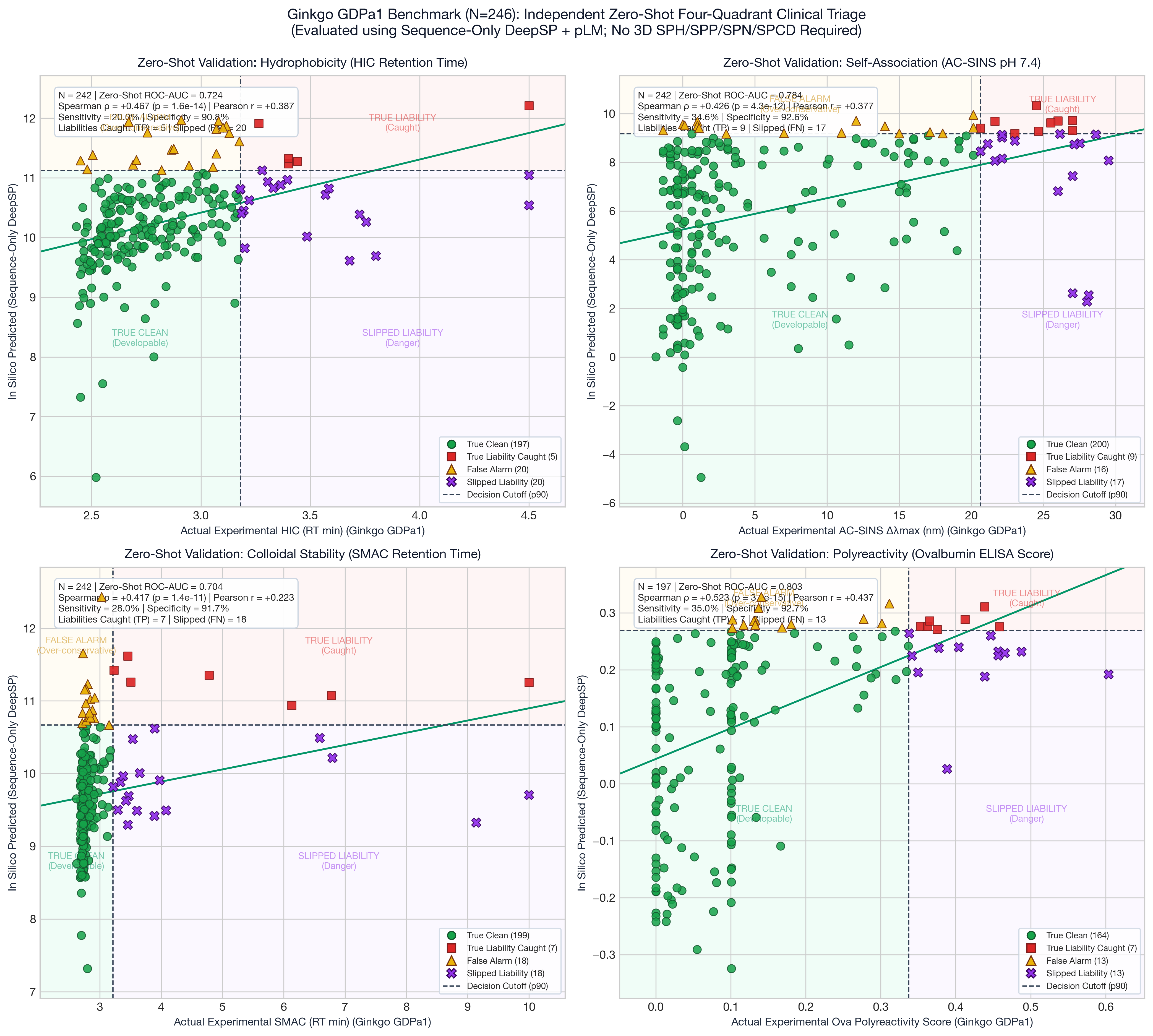
[!NOTE] Sequence-Only DeepSP Evaluation: All GDPa1 zero-shot predictions shown above were evaluated strictly using the Sequence-Only Model Pipeline (leveraging DeepSP convolutional spatial descriptors, language models, loop lengths, and electrostatics). Physical 3D structural homology modeling and structure-derived surface patch solvation potentials (
SPH,SPP,SPN,SPCD) were not used.
Key Findings from Independent GDPa1 Testing
- Robust Outlier Liability Discrimination: The model demonstrates outstanding liability classification power on unseen molecules, achieving an ROC-AUC of 0.784 on self-association (AC-SINS) and 0.804 on polyreactivity (Ova).
- Empirical Validation of Confidence Tiers: The high zero-shot statistical significance (\(p < 10^{-9}\)) across Hydrophobicity, Self-Association, Colloidal Stability, and Polyreactivity confirms the reliability of High Confidence metrics, while the low correlation on Expression Titer and \(T_{m1}\) confirms that host cell culture and melting curves are sensitive to specific laboratory batch protocols and should remain Informational Only.
Attribution & Non-Commercial Compliance Notice:
Zero-shot benchmark evaluation data is referenced from Arsiwala, A., et al., "A high-throughput platform for biophysical antibody developability assessment to enable AI/ML model training," mAbs 17, no. 1 (2025): 2593055 (DOI: 10.1080/19420862.2025.2593055), used under Creative Commons Attribution-NonCommercial 4.0 International (CC BY-NC 4.0). AbLead model weights were not trained or parameterized on this dataset; GDPa1 serves exclusively as an independent, zero-shot external literature evaluation benchmark.
Practical Guidance for AbLead Users
- Use as an Early Triage Filter: Treat the tool as an in silico screening mechanism to eliminate or re-engineer problematic clones early in discovery before advancing to expensive expression and purification campaigns.
- Sequence-First Screening: Screen entire variant libraries from sequence alone with DeepSP spatial descriptors, then generate 3D models for top candidates to refine surface patch assessments.
- Inspect Underlying Drivers for Red Flags: When a candidate receives a High Liability (Red) badge on Polyreactivity or Self-Association, inspect the 3D Surface Properties (
SPP,SPN,SPH) and pLM residue scores in the sequence grid to pinpoint specific engineering targets. - Discount Low-Confidence Properties: Rely primarily on High-Confidence developability readouts and use direct experimental assays for \(T_m\) and Expression Titer.
Freedom-to-Operate (FTO) & Data Provenance
All statistical machine learning models, inference pipelines, and scoring weights utilized in AbLead operate with strict compliance under commercial Freedom-to-Operate (FTO) standards:
- 100% Commercial FTO for Model Training Data: AbLead's predictive models are trained exclusively on factual, published scientific measurements and non-proprietary sequence records (Jain et al., 2017, PNAS; WHO INN therapeutic records; Thera-SAbDab under CC BY 4.0; and DeepSP under MIT / Apache 2.0). In accordance with established copyright and IP jurisprudence (Feist Publications v. Rural Telephone Service, 499 U.S. 340), factual experimental biophysical measurements and public biological sequences in scientific literature are un-copyrightable facts whose computational modeling constitutes lawful, fair commercial use.
- Separation of External Non-Commercial Benchmarks: Independent benchmark datasets that carry Non-Commercial licenses (such as Ginkgo Bioworks' GDPa1 under CC BY-NC 4.0) are utilized exclusively as external literature evaluation benchmarks for zero-shot generalization testing. They are never used to fit, parameterize, or train any model weights or software algorithms distributed within AbLead.
References
- Jain, T., Sun, T., Durand, S., et al., "Biophysical properties of the clinical-stage antibody landscape." Proceedings of the National Academy of Sciences 114, no. 5 (2017): 944–49.
- Tomar, J. G., et al., "In silico and in vitro developability assessment of clinical antibodies." Protein Science 25, no. 7 (2016): 1277–88.
- Sharma, V. K., et al., "In silico selection of therapeutic antibodies for development: Viscosity, clearance, and solubility." Proceedings of the National Academy of Sciences 111, no. 52 (2014): 18601–06.
- Tang, Z., Kalejaye, L. A., Wu, I. E., Terry, T., & Lai, P. K., "DeepSP: A deep learning framework for sequence-based prediction of antibody spatial charge map and spatial aggregation propensity." mAbs (2024).
- Arsiwala, A., et al., "A high-throughput platform for biophysical antibody developability assessment to enable AI/ML model training." mAbs 17, no. 1 (2025): 2593055.
- Shehata, L., et al., "Affinity Maturation Enhances Antibody Specificity but Compromises Conformational Stability." Cell Reports 28, no. 13 (2019): 3300–3308.
- Raybould, M. I., Marks, C., Krawczyk, K., et al., "Five computational developability guidelines for therapeutic antibody profiling." Proceedings of the National Academy of Sciences 116, no. 10 (2019): 4025–30.
- Schneider, C., Raybould, M. I., & Deane, C. M., "Thera-SAbDab: the Antibody Society's open-access database of antibody therapeutics." Nucleic Acids Research 50, no. D1 (2022): D1368–72.