Correct Sequence Annotation...
The Correct Sequence Annotation... tool allows users to review and override automated sequence classification, leader trimming, and liability motif scanning settings for selected entries in a project.
Accessing the Tool
Select one or more entries in the Project View, open the Edit menu, and choose Correct Sequence Annotation....
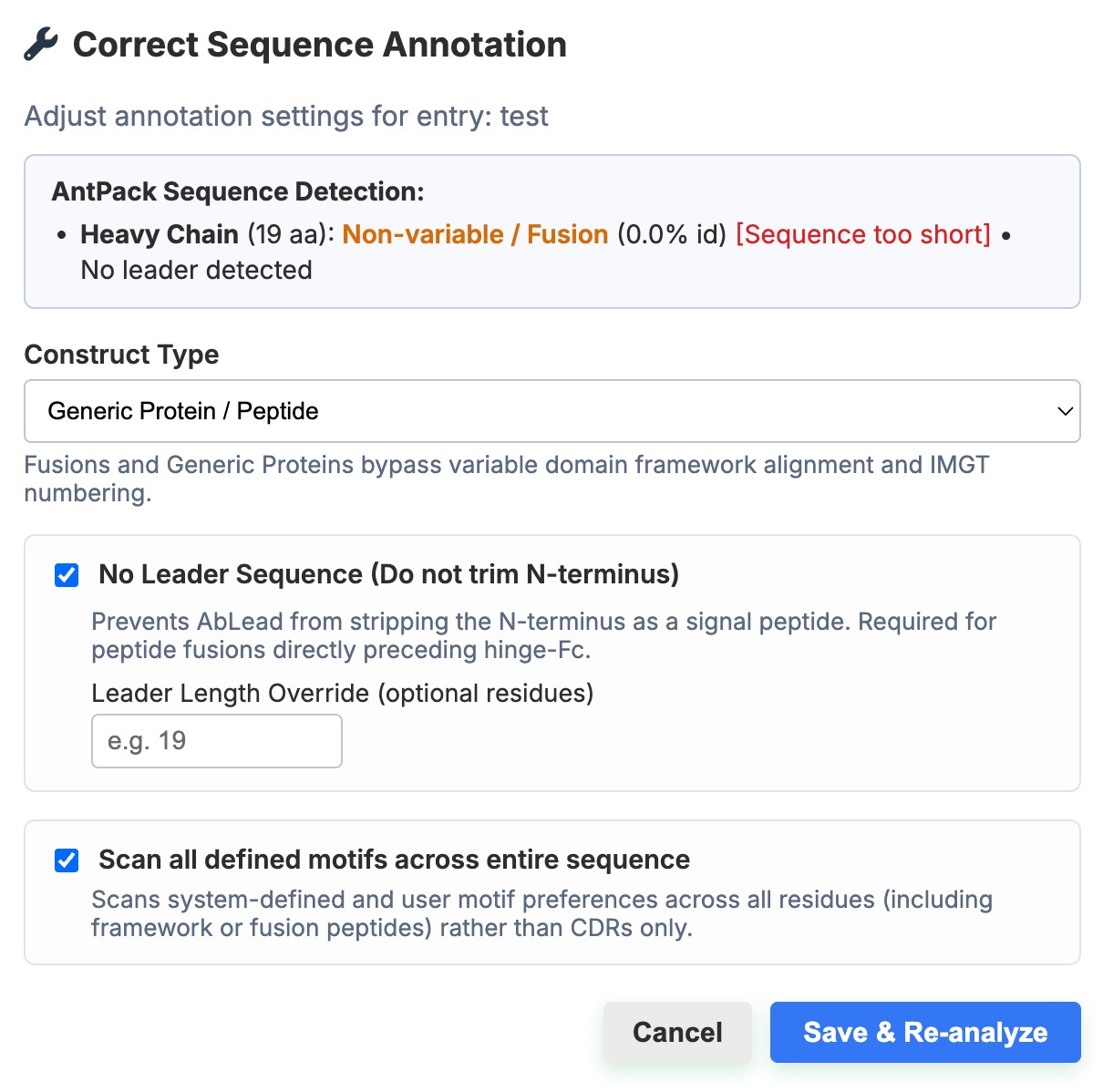
Features & Configuration
1. Automated Detection Diagnostics
The dialog displays automated sequence analysis computed by the AntPack annotation engine:
- AntPack Profile Score: Reports the percentage identity against antibody germline Hidden Markov Models (HMM). Authentic antibody variable domains typically score \(\ge 70\%\), while non-antibody scaffolds and peptides score \(< 35\%\).
- Construct Classification: Indicates whether the sequence was classified as a Standard Antibody, T-Cell Receptor (TCR), or Non-Antibody construct.
- Detected Leader Length: Displays the number of N-terminal residues identified as a signal peptide.
2. Construct Type Overrides
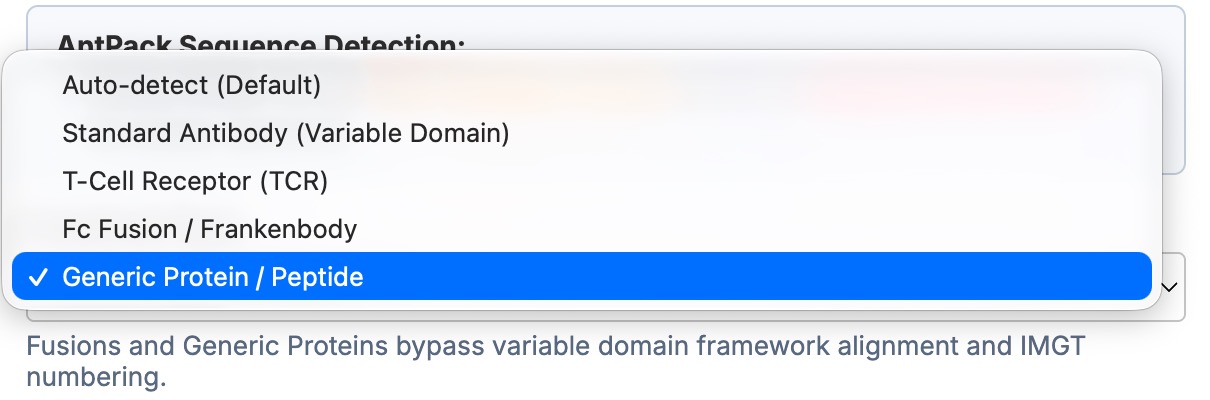
Users can override automated classification by choosing one of the following construct types:
- Auto-Detect (Default): Leverages AntPack HMM profiles to classify sequences automatically.
- Standard Antibody (Fv / mAb): Enforces antibody variable domain annotation, IMGT/Kabat numbering, CDR loop definitions, and antibody-specific developability models.
- T-Cell Receptor (TCR): Evaluates sequences using TCR \(\alpha/\beta/\gamma/\delta\) germline models and IMGT TCR numbering rules.
- Fc Fusion / Frankenbody / Peptide: Bypasses variable domain trimming, preserves engineered N-terminal fusion peptides, and evaluates the mature sequence with 1-based linear coordinates.
- Generic Protein Scaffold: Treats the entry as an arbitrary non-antibody protein, skipping antibody-specific CDR restrictions.
3. Signal Peptide & Leader Trimming
- No Leader Sequence (Starts at Mature Residue 1): Forces the leader offset to 0, ensuring that engineered N-terminal fusion partners, linkers, or leaderless peptides are evaluated from their very first residue.
- Custom Leader Length: Allows users to specify an exact number of N-terminal residues to strip (applied per chain).
4. Full-Sequence Liability Motif Scanning
- Scan All Defined Motifs Across Mature Sequence: By default, canonical antibody PTM liabilities (deamidation, isomerization, methionine/tryptophan oxidation, N-glycosylation, fragmentation, hydrolysis) are restricted to CDR loops. Enabling this option scans all canonical and user-defined motifs across the entire mature sequence, ensuring that liabilities within engineered fusion peptides or framework regions are detected and reported.
Automatic Re-Analysis
Saving updated annotations automatically initiates an incremental background re-analysis for the selected entries. Developability scores, liability counts, and RPEMHC immunogenicity profiles update immediately upon completion without affecting unselected clones.